
Most storage businesses treat onboarding as an admin task. Sign the agreement, hand over the gate code, done. But understanding what does storage customer onboarding mean in practice reveals something far more consequential. It is the structured process of moving a new customer from signed contract to fully operational unit access, covering account setup, document handling, access credential assignment, payment processing, and compliance verification. Get it right and you retain customers, run a tighter operation, and spend less time fixing errors. Get it wrong and you lose both time and trust before the customer has stored a single box.
Table of Contents
- Key takeaways
- What storage customer onboarding actually involves
- Why traditional onboarding creates operational headaches
- Modern solutions for faster, cleaner onboarding
- Best practices for repeatable onboarding
- My view: onboarding is where the sale is won or lost
- How Moovi supports your onboarding operation
- FAQ
Key takeaways
| Point | Details |
|---|---|
| Onboarding is more than paperwork | The storage onboarding process spans unit assignment, access setup, compliance, and payment in one connected workflow. |
| First impressions drive retention | Customer onboarding shapes first impressions that directly influence long-term loyalty and repeat business. |
| Manual workflows cost time | Traditional onboarding across disconnected systems typically takes 30 to 45 minutes per customer and creates duplication errors. |
| Automation cuts onboarding to minutes | Integrated platforms can reduce staff time per onboarding to under 10 minutes while improving data accuracy. |
| Success means unit access, not task completion | Effective onboarding is measured by whether the customer can physically access and use their unit, not just whether forms are signed. |
What storage customer onboarding actually involves
The phrase "customer onboarding" is borrowed from the software industry, where it describes the period between a customer signing up and achieving their first meaningful result with a product. In storage, the principle is identical. Onboarding transitions a new customer from contract to full setup, including account creation, unit assignment, access authorisation, and operational validation.
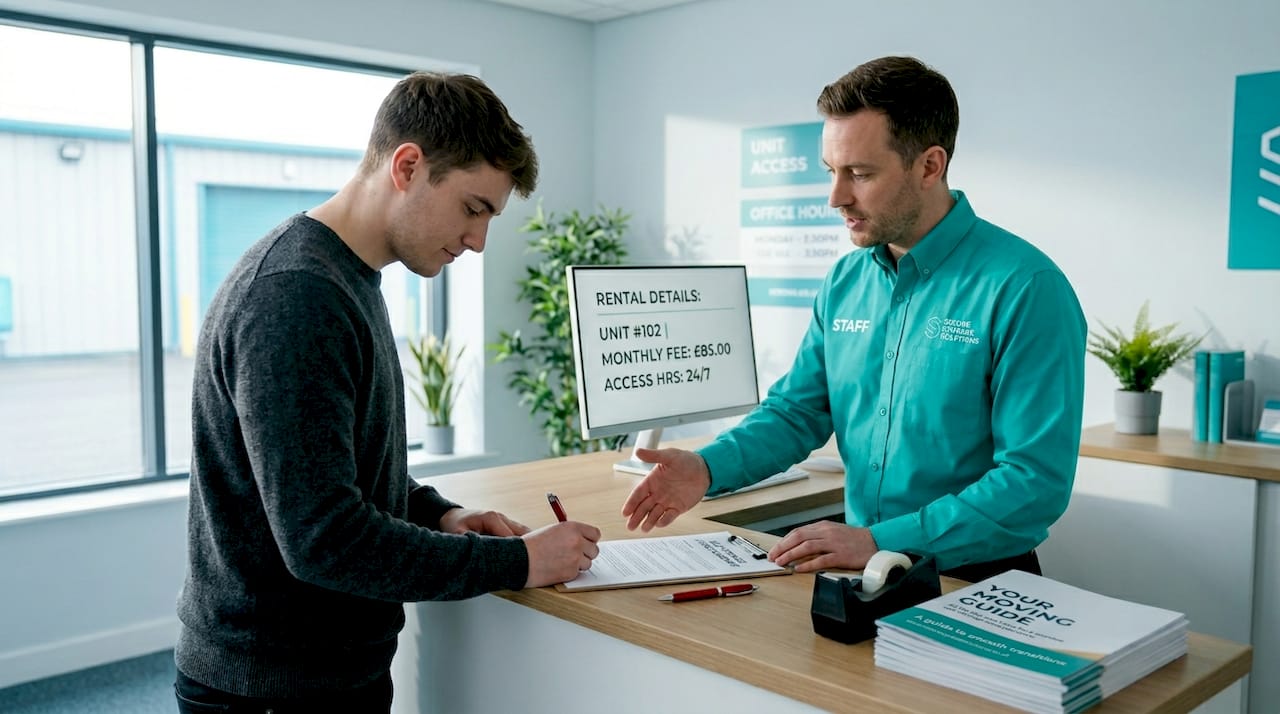
What makes storage onboarding distinctive is the physical dimension. Unlike a SaaS product, a storage unit requires a customer to physically access a facility, understand site rules, and receive working credentials before they can use what they have paid for. That physical handover is where most operational failures occur.
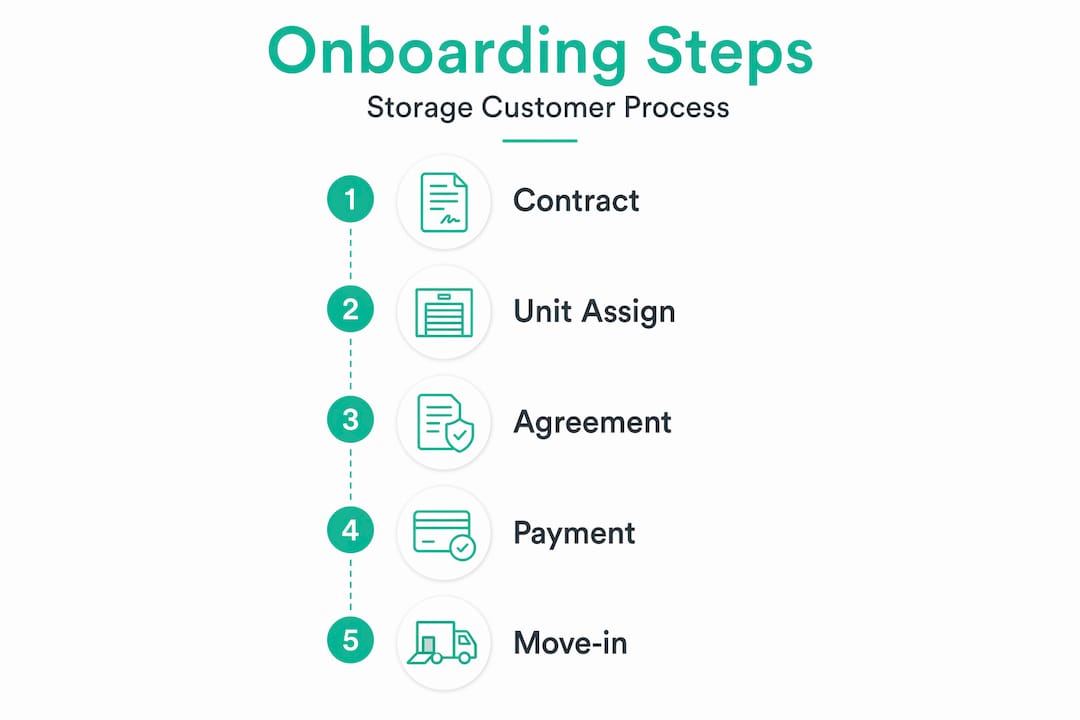
A well-run storage onboarding process follows a clear sequence:
- Sales to operations handoff. The moment a prospect commits, their information moves from the sales or enquiry stage into an operational record. Contact details, unit preferences, move-in date, and any special requirements are captured and passed to the team managing the facility.
- Unit assignment and pricing confirmation. The right unit is matched to the customer's needs, availability is verified, and the agreed price is confirmed in writing. This step prevents the common problem of a customer arriving to find their expected unit unavailable.
- Rental agreement generation and signing. A formal agreement is produced, covering terms, payment schedule, access rules, and liability. Online document signing and instant payment processing can reduce move-in time to a matter of minutes, allowing customers to access their unit on their own schedule.
- Payment processing. The first payment is collected and confirmed before access is granted. This step also sets up the recurring billing structure for the rental period.
- Access credential setup. Gate codes, key fobs, or digital access credentials are generated and assigned to the customer's account. This is not a separate administrative task. It must be linked directly to the rental record.
- Customer orientation. The customer is briefed on facility rules, access hours, insurance requirements, and who to contact if something goes wrong. Onboarding is not just paperwork but ensuring the customer understands how to use their unit and the facility.
- Record verification and compliance check. Identity documents, payment details, and signed agreements are filed in an auditable system. This is not optional. It is a governance requirement.
From contract to move-in readiness, a well-managed process typically takes between one and three working days when handled manually. With automation, that window shrinks considerably.
Why traditional onboarding creates operational headaches
Most storage businesses did not design their onboarding process. It evolved. A spreadsheet for unit availability here, a folder of scanned agreements there, access codes managed separately in a gate control system. The result is a workflow that works until it does not.
The most common problems include:
- Data duplication and entry errors. When staff manually transfer customer information between systems, mistakes happen. A wrong gate code, a misrecorded move-in date, or a missing document can create problems that take hours to resolve.
- Staff time overload. Manual workflows spanning multiple systems are time-intensive, often requiring 30 to 45 minutes per onboarding. During busy periods, this creates backlogs and slows move-ins.
- Customer dissatisfaction. A customer who arrives to find their access code does not work, or who waits two days for a rental agreement, forms a negative first impression that is difficult to reverse. First impressions strongly influence retention and loyalty.
- Compliance exposure. Onboarding document recordkeeping is mandatory for operations handling sensitive identity and payment data. Scattered files and informal email exchanges do not constitute a governed document pipeline.
- Fragmented visibility. When unit assignment, payment, and access credentials live in separate systems, no one has a complete view of a customer's onboarding status. Managers cannot tell at a glance which customers are fully set up and which are still waiting on a step.
Pro Tip: Audit your current onboarding process by timing how long it takes from contract signing to a customer's first successful gate entry. That number is your baseline. Everything you do to reduce it improves both staff efficiency and customer experience.
The importance of onboarding storage customers correctly goes beyond convenience. A slow or error-prone process directly affects occupancy rates, because customers who struggle to get started are more likely to cancel before they have even moved in.
Modern solutions for faster, cleaner onboarding
The gap between a manual onboarding process and an automated one is not incremental. It is transformational. Automated onboarding platforms connecting with storage management software via APIs allow real-time updates and reduce staff time from 30 to 45 minutes to under 10 minutes per onboarding.
Here is how manual and automated approaches compare across the key onboarding steps:
| Onboarding step | Manual process | Automated process |
|---|---|---|
| Unit availability check | Staff checks spreadsheet or legacy system | Real-time availability pulled from integrated platform |
| Rental agreement | Printed or emailed PDF, returned by post or scan | Digital agreement sent, signed, and stored instantly |
| Payment processing | Card machine or bank transfer, manually recorded | Online payment triggers automatic account activation |
| Access credential setup | Staff manually enters code into gate system | Access credentials generated and sent automatically on payment confirmation |
| Document filing | Scanned and saved to a shared folder | Automatically filed in an auditable, searchable record |
| Customer communication | Ad hoc phone calls or emails | Automated confirmation with unit details and access instructions |
The practical effect of this shift is significant. A customer can complete the entire rental process online, receive their unit number and access credentials immediately after payment, and arrive at the facility ready to use their unit without any staff involvement. That is not a theoretical benefit. It is the standard that well-run storage businesses are already delivering.
Pro Tip: When evaluating software for your storage onboarding process, prioritise platforms that connect unit assignment, rental agreements, payment, and access control in a single record. Separate systems that do not talk to each other recreate the same fragmentation you are trying to eliminate.
Integrating access codes and rental agreements into a unified, auditable workflow is the single most impactful change most storage businesses can make to their onboarding operation. It removes the manual duplication step that causes most errors and delays.
Best practices for repeatable onboarding
Knowing how to onboard storage customers effectively comes down to treating the process as a structured workflow with defined ownership, clear milestones, and measurable outcomes. Here is what that looks like in practice:
- Define the handoff point precisely. Onboarding begins the moment a prospect decides to become a customer, not when the agreement is signed. Sales teams should capture complete customer information and pass it to operations in a single, structured handoff rather than a series of informal messages.
- Assign clear ownership for each step. Every stage of the onboarding process should have a named owner. Unit assignment is operations. Agreement generation is administration. Access setup is the facility manager. When ownership is ambiguous, steps get missed.
- Use completion criteria, not task lists. Treat onboarding success as the customer's ability to access and use their unit physically, not just the completion of administrative tasks. A signed agreement with a broken gate code is not a completed onboarding.
- Maintain auditable records throughout. Structured management of collected documents ensures operational continuity and traceability. Every document, payment confirmation, and access credential change should be logged against the customer's record.
- Benchmark and improve your timeline. Structured sequences with milestones at 30 to 60 days help measure onboarding success. Set a target for your average time from contract to first access, track it monthly, and investigate any onboarding that exceeds it.
- Collect feedback at the end of onboarding. A short message asking the customer about their move-in experience takes two minutes to send and gives you direct intelligence on where the process is breaking down.
The businesses that do this well share one characteristic: they treat onboarding as a repeatable system, not a series of one-off tasks. That mindset is what separates storage operators who scale efficiently from those who hit a ceiling every time they get busy.
My view: onboarding is where the sale is won or lost
I've worked with enough storage and removals businesses to know that onboarding rarely gets the attention it deserves. Most operators focus on lead generation and sales conversion, then assume the hard work is done once the agreement is signed. It is not.
What I've seen repeatedly is that the operational cost of poor onboarding is invisible until it becomes a crisis. A customer who cannot access their unit on move-in day does not usually complain loudly. They just leave at the end of their first rental period and do not come back. That churn is almost never attributed to onboarding. It gets written off as a customer who "just needed short-term storage." But the root cause is often a first experience that felt disorganised and unreliable.
The businesses I've seen get this right are the ones who treat the storage service onboarding steps with the same rigour they apply to sales. They map the process, assign ownership, measure it, and improve it. The payoff is not just faster move-ins. It is a customer base that trusts the operation and stays longer.
My honest view is that onboarding is the most underleveraged competitive advantage in the storage industry. Most facilities offer similar units at similar prices. The ones who win long-term are the ones who make the first week feel effortless.
— Sam
How Moovi supports your onboarding operation
If your storage onboarding process still relies on spreadsheets, email chains, and manual data entry across separate systems, you are spending more time and money than you need to on every new customer.

Moovi is the operating platform for the removals and storage industry. It brings inventory management, customer records, warehouse location mapping, and the customer portal into one connected place, so nothing falls through the gaps between systems. Quotes, payments, digital sign-off, and storage location data all sit on a single record. Your team always knows where a customer is in the process, and your customer always knows what happens next. If you are ready to run a tighter, faster onboarding operation, explore Moovi and see how it fits your workflow.
FAQ
What does storage customer onboarding mean?
Storage customer onboarding is the structured process of moving a new customer from signed contract to fully operational unit access. It covers account setup, unit assignment, rental agreement signing, payment processing, access credential delivery, and compliance recordkeeping.
How long does the storage onboarding process take?
Manual onboarding across disconnected systems typically takes 30 to 45 minutes per customer. Automated platforms with integrated unit management, document signing, and access control can reduce this to under 10 minutes.
Why does good onboarding matter for storage businesses?
Poor onboarding creates data errors, slow move-ins, compliance gaps, and dissatisfied customers who are unlikely to renew. A structured onboarding process directly improves retention, operational efficiency, and facility revenue.
What are the key steps in storage service onboarding?
The core steps are: sales to operations handoff, unit assignment, rental agreement generation and signing, payment processing, access credential setup, customer orientation, and document filing for compliance.
When does customer onboarding begin?
Onboarding begins the moment a prospect decides to become a customer, not when the agreement is formally signed. Early alignment between sales and operations on pricing, documentation, and move-in expectations sets the foundation for a smoother process.