
When a customer rings to request their belongings from storage, the clock starts immediately. Delays, mis-picks, and poor communication in the customer item retrieval process are among the most common causes of complaints in removal and storage businesses. They also carry a real cost: repeat handling, wasted labour, and customers who do not come back. This guide covers the full retrieval workflow, from inventory preparation and authorisation through to verification and exception handling, with practical strategies and technology applications that operators can apply directly to their own businesses.
Table of Contents
- Key takeaways
- The customer item retrieval process: getting the foundations right
- Executing the retrieval workflow step by step
- Optimising retrieval efficiency through technology
- Verification and exception handling
- My take on retrieval efficiency
- How Moovi supports your retrieval operations
- FAQ
Key takeaways
| Point | Details |
|---|---|
| Preparation prevents errors | Accurate, barcoded inventory linked to customer accounts is the single biggest factor in retrieval accuracy. |
| Structure retrieval as a controlled process | Treating each retrieval as an authorised state change, not an ad-hoc warehouse task, reduces mis-picks and disputes. |
| Reservation locks prevent double-booking | Applying inventory reservations before dispatch and reconciling immediately after pickup avoids billing conflicts. |
| Technology should follow workflow design | Automate only once your retrieval workflow is clearly defined; technology amplifies both good and bad processes. |
| Verification closes the loop | Comparing retrieved items against the original request before handover catches discrepancies before they reach the customer. |
The customer item retrieval process: getting the foundations right
In the removals and storage industry, the formal term for this operational area is goods retrieval or stock retrieval, though many operators simply call it customer collection or item pickup. Whatever you call it internally, the principles are the same: the right items must reach the right customer, in the right condition, at the right time.
That starts long before a retrieval request arrives. The work happens at intake.
Inventory preparation and barcoding
Every item that enters your warehouse should be logged against a specific customer account before it is placed on a shelf. This sounds obvious, but many smaller operators still rely on handwritten labels and paper manifests. When a retrieval request comes in three months later, those records are either missing, illegible, or wrong.
The most effective item retrieval strategy begins with standardised containers. Containerised storage systems link inventory to sealed, coded containers rather than individual items, which means retrieval becomes a matter of selecting the correct container rather than hunting through open shelving. Each container carries a unique code that audits what is inside. This dramatically reduces handling steps and reconciliation points.
Barcoded boxes paired with photographic records go further still. Providers using this model can schedule pickups and deliveries within 24 to 48 hours after a request, with access managed through tracked, scheduled deliveries. The speed is possible because the inventory record is clean from the start.
| Preparation tool | Operational benefit |
|---|---|
| Barcoded containers | Instant item lookup; reduces manual searching |
| Photographic intake records | Resolves condition disputes at handover |
| Digital inventory linked to customer accounts | Enables filtered, permission-based retrieval |
| Standardised packaging | Reduces handling damage and mis-identification |
| Scheduled delivery slots | Sets clear customer expectations and reduces failed collections |
Pro Tip: When logging items at intake, record the container code, a photo, and the customer account reference in a single step. Any system that requires these to be entered separately will create gaps over time.
Customer communication at the scheduling stage
Clear communication before retrieval begins is as important as the warehouse process itself. Customers who do not know when to expect their items, or who receive them without prior notice, generate unnecessary inbound calls and complaints. Set a fixed window, confirm it in writing, and send a reminder the day before. This alone reduces failed deliveries and the repeat handling costs that come with them.
Executing the retrieval workflow step by step
A well-designed item retrieval workflow treats each retrieval as a controlled, authorised process rather than an ad-hoc warehouse action. Designing retrieval this way improves accuracy and builds customer trust because every step is traceable.
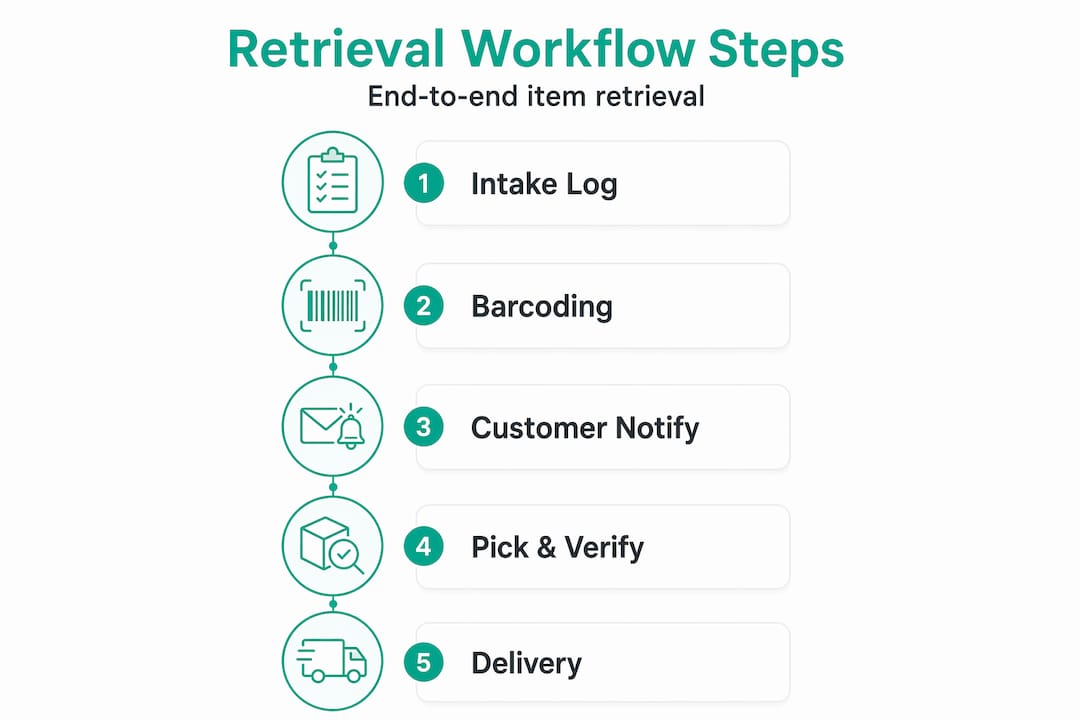
The standard retrieval workflow for a removal or storage business runs as follows:
-
Retrieval request received. The customer contacts you by phone, email, or customer portal. Log the request immediately against their account, noting the items requested, the preferred delivery date, and any access restrictions.
-
Item lookup and verification. Search the inventory system using multiple criteria: customer name, account number, container code, and item description. Multi-criteria item lookup with permission-based filtering reduces mis-picks by narrowing results to only what the customer is authorised to retrieve. If a single match is found, move directly to the next step. If multiple matches appear, confirm with the customer before proceeding.
-
Authorisation validation. Before any physical picking begins, confirm the requester is authorised to collect the items. Pre-retrieval authorisation mapping is the highest-risk step in the entire process. Explicitly linking the retrieval request to the customer account and the specific items listed on their storage agreement prevents the wrong items from leaving the warehouse.
-
Inventory reservation. Once authorised, place a reservation lock on the items in your system. This prevents the same items from being allocated to another job or retrieval request while picking is in progress.
-
Picking and packing. The warehouse operative retrieves the container or items using the verified list. Items are checked against the request at the point of picking, not afterwards.
-
Delivery scheduling. Confirm the delivery slot with the customer and update the job record. If the customer is collecting in person, send a confirmation with the collection address and any access requirements.
-
Handover and sign-off. Obtain a signature or digital confirmation at handover. Update the inventory record immediately to reflect the change in stock status.
Pro Tip: Retrieval labour costs rise sharply when pickers have to make multiple trips to confirm item details. Give your warehouse team a printed or digital pick list that includes the container code, a photo thumbnail, and the customer account reference. One trip, one pick.
Optimising retrieval efficiency through technology
Technology does not fix a broken process. It makes a good process faster and a bad process more expensively broken. With that said, there are clear technology applications that deliver measurable gains once your retrieval workflow is defined.
Automated storage and retrieval
For businesses operating at scale, AS/RS robotic systems like the Skypod® reduce picker travel and congestion by delivering bins directly to a fixed workstation. The software controls gate release to prevent congestion and maintain consistent throughput even during volume spikes. For most independent removal and storage operators, full robotics is not the immediate priority. But the principle applies at any scale: reduce the distance your team travels to retrieve items, and you reduce both time and error rate.
Inventory visibility and allocation logic
Omnichannel inventory management systems aggregate stock across multiple locations and use configurable business rules to select the optimal fulfilment source. For a storage business with multiple sites or container yards, this means the system can automatically identify which location holds the customer's items and route the retrieval request accordingly. Sub-second inventory updates prevent double-allocation.
Retrieval governance layers
A governance layer sits upstream of the physical picking process. Applying deterministic retrieval policies before searching, such as restricting results by customer permissions and item status, reduces misaligned retrieval attempts and the rework that follows. In practical terms, this means your system should never surface items belonging to another customer during a retrieval lookup, regardless of how the search is conducted.
| Technology approach | Operational benefit | Best suited to |
|---|---|---|
| Barcoded inventory with digital records | Fast, accurate item lookup | All business sizes |
| Reservation locking | Prevents double-booking | Multi-staff operations |
| Automated storage and retrieval | Reduces picker travel and congestion | High-volume warehouses |
| Distributed order management | Optimises retrieval source across locations | Multi-site businesses |
| Retrieval governance layer | Enforces permission-based lookup accuracy | Any business with multiple customers |
Pro Tip: Before investing in any retrieval technology, map your current workflow on paper first. Identify where errors actually occur. Most businesses find the problem is in authorisation or item lookup, not in the physical picking itself.
Verification and exception handling
Retrieval does not end when the items leave the shelf. Verification is the step that closes the loop and protects both the customer and your business.

Immediately after picking, compare the retrieved items against the original request. This reconciliation step should happen before the items leave the warehouse, not on the doorstep. Reservation-based workflows with immediate reconciliation after pickup prevent double-booking and clarify customer billing when disputes arise.
Common pitfalls during verification, and how to avoid them:
- Skipping the pre-handover check. Operatives under time pressure often skip the final item check. Build it into the handover procedure as a mandatory step, not an optional one.
- Failing to update inventory records in real time. If your system still shows an item as in storage after it has been collected, the next retrieval request for that customer will generate a false result. Update records at the point of handover, not at the end of the day.
- No photographic evidence at handover. A photo of the items at the point of delivery, signed off by the customer, resolves the majority of condition disputes before they escalate.
- Poor exception escalation paths. When a discrepancy is found, your team needs a clear process: who to call, what to log, and how to communicate the delay to the customer. An undocumented exception becomes a complaint.
After every retrieval, send the customer a confirmation that includes what was collected, the date and time, and the name of the operative. This takes two minutes and eliminates a significant proportion of follow-up queries.
My take on retrieval efficiency
I've worked with enough removal and storage operators to know that the conversation about retrieval almost always starts in the wrong place. Everyone wants to talk about speed. How quickly can we get items out? Can we automate the picking? The real problem, in most cases, is not speed at all.
In my experience, the businesses with the worst retrieval track records are not slow. They are inaccurate. They retrieve the wrong items quickly. They deliver to the wrong address efficiently. Speed without accuracy is just expensive failure delivered faster.
What actually changes outcomes is treating retrieval as a governed, authorised process from the moment the request comes in. The businesses that get this right have clean inventory records, clear authorisation steps, and a verification check before handover. They do not necessarily have the most sophisticated technology. They have the most disciplined workflow.
I'd also push back on the idea that you need to automate everything before you can improve. Incremental changes, starting with barcoded containers and a proper item lookup procedure, will deliver more measurable improvement in the first six months than a full system overhaul. Get the workflow right first. Then let technology amplify it.
The other thing I've learned: customer communication is underrated as a retrieval tool. A customer who knows exactly when their items are arriving does not ring the office three times to check. That is time your team gets back.
— Sam
How Moovi supports your retrieval operations
If the retrieval challenges described in this article sound familiar, Moovi is built to address them directly.

Moovi is the operating platform for the removals industry. It brings inventory management, warehouse location mapping, customer records, and job scheduling into a single connected system. Your team can locate any container instantly, link retrieval requests to customer accounts, and update inventory records in real time, all without switching between spreadsheets, WhatsApp messages, and separate booking tools. Every job carries through from first enquiry to final sign-off on one record. To see how Moovi handles retrieval workflows in practice, explore the platform and book a demo with the team.
FAQ
What is the customer item retrieval process in storage businesses?
The customer item retrieval process is the end-to-end workflow for locating, authorising, picking, and delivering a stored customer's items back to them. It includes request logging, inventory lookup, authorisation validation, picking, and post-handover reconciliation.
How do you reduce mis-picks during item retrieval?
Use multi-criteria item lookup with permission-based filtering, and validate authorisation before any physical picking begins. Linking each retrieval to a specific customer account and item list is the most effective way to prevent the wrong items from leaving the warehouse.
Why is inventory reservation important in the retrieval workflow?
Placing a reservation lock on items once a retrieval is authorised prevents the same stock from being allocated to another job. Reservation-based state management with immediate post-pickup reconciliation also reduces billing disputes and customer service escalations.
When should a storage business invest in retrieval automation?
Automate after your retrieval workflow is clearly defined and consistently followed. AS/RS systems deliver the greatest gains at high volume, but barcoded inventory and digital records provide significant accuracy improvements for businesses of any size before full automation is needed.
How should exceptions be handled during the retrieval process?
When a discrepancy is found between the retrieved items and the original request, log it immediately, notify the customer with a revised timeline, and escalate through a defined internal path. Updating inventory records and sending a post-retrieval confirmation to the customer prevents most exceptions from becoming formal complaints.